Why Do Some Born Again Christians Start Celebrating Jewish Holidays?
NEW YORK (JTA) — On the night of Rosh Hashanah, thousands of people will leave work, gather in congregations beyond the globe and worship God, the ruler of the world. Ten days afterwards they will begin a fast and get together again to pray, this time atoning for their sins.
On both occasions they will praise Jesus Christ and pray for his return.
They are non Jews, nor are they Jews for Jesus. Rather, these congregants are members of an evangelical Christian movement called the Living Church of God. On the days Jews know as Rosh Hashanah and Yom Kippur, these Christians celebrate what they phone call the Banquet of Trumpets and Mean solar day of Amende.
"We're not trying to be Jewish," said Dexter Wakefield, a Living Church minister and the church'south spokesman. "We're obeying God's commandments. The holy days have great meaning for the Christians who keep them."
Living Church of God is one of a few evangelical groups that discover Christianity every bit they believe Jesus observed it: according to the dictates of the Hebrew Bible. That means no Christmas and no Easter — holidays the church rejects as pagan in origin. It also means that members observe their Sabbath like the Jews: from Friday night to Saturday night. The mainstream Christian custom of observing the Sabbath on Sunday, they believe, is another departure from the authentic Christianity of Christ.
Though the Living Church of God, which has about 10,000 members, advocates observing the Sabbath on Saturday equally well as Jewish holidays, they are non Messianic Jews, who self-identify as Jewish and use Hebrew scripture and liturgy. Nor are they Seventh-solar day Adventists, who observe a Saturday Sabbath but no other Jewish holidays.
The church has virtually 400 congregations on half dozen continents, and nearly of its membership is in North America, with headquarters in Charlotte, North Carolina. Information technology is governed past a Council of Elders and is an ideological outgrowth of the philosophy of Herbert Armstrong, whose preaching of One-time Testament observance inspired several churches that see themselves outside of the evangelical mainstream.
For the Living Church of God, Rosh Hashanah and Yom Kippur — the former begins this year on the evening of Sept. 20 and the latter at dusk Sept. 29 — are two of vii festivals celebrated beyond the yr. Those festivals correspond to the five Jewish holidays allowable in the Torah – Rosh Hashanah, Yom Kippur, Sukkot, Passover and Shavuot. The church building gets to vii past treating Shemini Atzeret, the vacation at the end of Sukkot, every bit a split festival, and by splitting Passover in ii – the start day and everything that comes afterward.
"These days were conspicuously commanded in the Onetime Attestation, and their observance by Christ and the Apostles in the New Testament certainly ratifies them for the Christian Church," the church's founder, Roderick Meredith, wrote in a pamphlet. "True Christians are to go along holy the days God made holy. And we are to follow the example of Jesus and the original Apostles in so doing."
These holidays correspond to the annual agricultural wheel, and take also taken on Jewish historical significance. But for the church, they reflect steps in the second coming of Jesus and the world's ultimate redemption.
Rather than marking the New year, Rosh Hashanah — a one-day holiday chosen the Feast of Trumpets, a reasonably literal translation of its name in the Torah, Yom T'ruah — marks the day when Jesus will appear over again hailed by trumpets. Yom Kippur, translated as the 24-hour interval of Amende, marks the solar day when Satan will finally be defeated.
"Can we film a massive trumpet blast literally shaking the earth to denote Christ'southward return as King of Kings?" Meredith'due south pamphlet reads. "Can we film the truthful saints of God — who follow Him wherever He goes — rising to meet Christ in the air, to join forever with their Savior and help Him in ruling this rebellious planet? All of these things volition exist heralded by the seventh trumpet!"
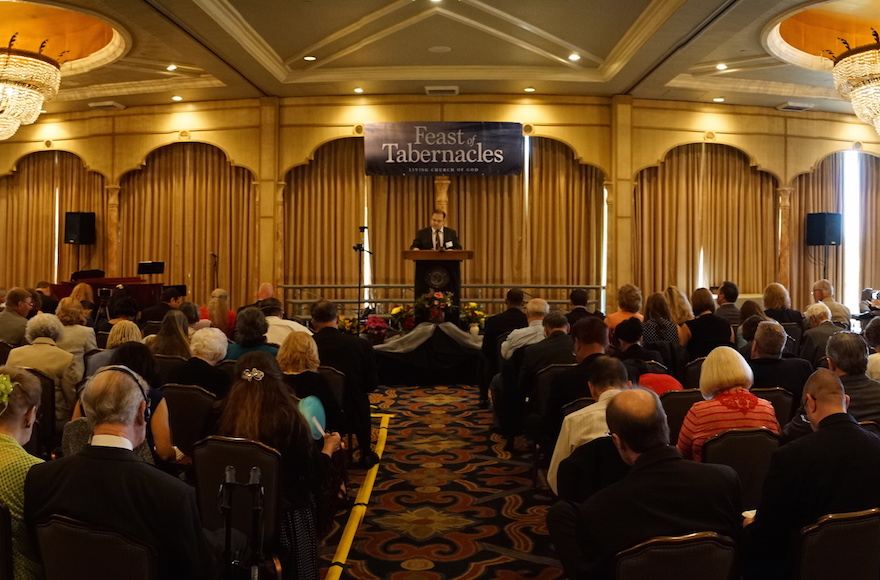
A Living Church of God congregation in San Diego celebrates the Feast of Tabernacles — the church'southward name for Sukkot — in 2016. (Courtesy of the Living Church of God)
The church celebrates each day with a service – brusque by Jewish High Holiday standards – that includes a short and long sermon on the theme of the day, bookended past hymns. Like observant Jews, on the Day of Amende congregants will take the day off and abjure from eating and drinking. But on the Loftier Holidays they manipulate with Jewish rituals like dipping apples in honey, wearing white robes known as kittels or blowing a shofar.
Four days after the Twenty-four hours of Amende, the church's congregations will leave their homes for a temporary dwelling house, as Jews do on Sukkot. Merely that abode will be a resort or cabin – not a backyard sukkah made of cloth, forest and branches. The church sees the holiday as a time to leave home and gather in another place, but that place need not be open to the elements.
The church also observes several other Quondam Attestation commandments. Members refrain from eating foods expressly prohibited in the Bible – like shellfish – and abstain from work from sunset Friday to dusk Saturday, by and large corresponding to the Jewish Shabbat. But there is no set of prohibited practices on Saturday.
"We teach that you do not practice your weekly labor," Wakefield said. "If you work at the factory during the week, you lot're not working by sundown Friday."
While most evangelical groups practice not observe the Former Testament like the Living Church of God, many do ascribe significance to some of its commandments. Many evangelical leaders, for example, accept cited Leviticus in their opposition to same-sex marriage. And some evangelical groups have voiced support for displaying the X Commandments at courthouses.
Cynthia Lindner, manager of Ministry Studies at the University of Chicago Divinity School, says Christians are drawn to these verses because they define codes of interpersonal comport.
"There are [Old Testament] texts that are focused on prescribing behavior far more than and then than in the New Testament," she said. "The texts and codes of the Hebrew Bible are easily appropriated when you desire to make an argument about beliefs."
In recent years, some evangelical groups have held Passover seders, partly as a re-enactment of Jesus' Final Supper, considered to have been itself a seder. Other Christian groups, including some Christian Zionists, have taken on other Jewish rituals, such as wearing a prayer shawl or blowing a shofar.
"I call up a lot of Christians have the thought that Judaism is more accurate, more ancient, closer to the will of God than what a lot of the churches accept become in mod times," said Jon Levenson, a professor of the Hebrew Bible at Harvard Divinity Schoolhouse. "At that place'south this notion that church tradition has gotten farther and further from the existent word of God, and that somehow the Jews and their Bible is closer to the existent discussion of God, and we should start taking those things on."
There are a few Jewish community the Living Church of God doesn't take on. While Jews accept special prayer books meant but for the High Holidays, Wakefield said at that place isn't a special liturgy for the solar day.
"Occasionally someone will bring a shofar just for the fun of it," said Wakefield, who served every bit a pastor to several Florida churches before moving to piece of work in the church'south headquarters. "Information technology's not a particular ritual that we do. Information technology's a delightful affair to do."
Source: https://www.jta.org/2017/08/24/united-states/these-christians-celebrate-rosh-hashanah-and-yom-kippur
0 Response to "Why Do Some Born Again Christians Start Celebrating Jewish Holidays?"
Post a Comment