And Shes Keep Calling Me Back Again Beatles
| "I've Simply Seen a Face" | |
|---|---|
 Cover of the Northern Songs canvas music | |
| Song by the Beatles | |
| from the anthology Help! | |
| Released | 6 August 1965 (1965-08-06) |
| Recorded | 14 June 1965 (1965-06-14) |
| Studio | EMI, London |
| Genre | Folk rock, country and western, pop rock |
| Length | ii:02 |
| Label | Parlophone |
| Songwriter(s) | Lennon–McCartney |
| Producer(s) | George Martin |
"I've Just Seen a Face" is a song by the English rock band the Beatles. It was released in Baronial 1965 on their album Help!, except in Due north America, where it appeared as the opening track on the December 1965 release Rubber Soul. Written and sung by Paul McCartney, the song is credited to the Lennon–McCartney partnership. The song is a cheerful love ballad, its lyrics discussing a beloved at outset sight while carrying an adrenaline rush the singer experiences that makes him both enthusiastic and inarticulate.
Originally titled "Auntie Gin's Theme", the song began as an uptempo land and western-style piano slice. McCartney then added lyrics that may accept been inspired by his relationship with actress Jane Asher. The Beatles completed the track in June 1965 at EMI Studios in London on the same twenty-four hours they recorded "I'grand Down" and "Yesterday". The recording fuses country and western with several other musical genres, including folk stone, folk, pop stone and bluegrass. The commencement Beatles rails without a bass guitar, it features three audio-visual guitars, a brushed snare and maracas.
Several reviewers have described "I've Only Seen a Face" in favourable terms, highlighting its rhyming lyricism and McCartney's vocal delivery, and described it as an overlooked song. Its replacement of "Drive My Car" on the North American version of Rubber Soul furthered the album's identity as a folk stone work, although some commentators view this change as masking the band's belatedly-1965 creative developments. It was among the first Beatles songs McCartney played alive with his grouping Wings, and versions from their 1975–76 earth tour appear on the 1976 alive anthology Wings over America and in the 1980 concert motion picture Rockshow. The song has been covered past several bluegrass bands, including the Charles River Valley Boys, the Dillards and the New Grass Revival with Leon Russell. George Martin, Holly Cole and Brandi Carlile are amid the other artists who accept covered it.
Background and inspiration [edit]
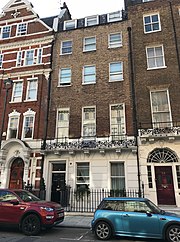
Although the song is credited to the Lennon–McCartney songwriting partnership,[1] John Lennon and Paul McCartney each identified "I've Just Seen a Confront" as having been written entirely by McCartney.[2] McCartney recalled writing it in the basement music room at 57 Wimpole Street in central London.[3] The house was the family home of his girlfriend, actress Jane Asher, where McCartney lodged from Nov 1963.[4] Working on a piano, he composed the melody first, beginning it as an uptempo country and western-inflected piece.[5] After he played information technology on the piano at a family gathering,[six] his aunt Gin enjoyed the tune, prompting him to give it the working title "Auntie Gin's Theme".[7] [notation 1] He added fast-paced lyrics which may have been inspired by his relationship with Asher, turning the vocal into a cheerful love carol.[eleven]
McCartney completed "I've Just Seen a Face" too belatedly for inclusion in the Beatles' 2nd characteristic film, Help!,[i] most of the songs for which were recorded in February 1965.[12] He presented it to the band in mid-June,[xiii] soon later returning from holidaying in Portugal with Asher.[14] During the vacation, he also wrote the lyrics to his carol "Yesterday".[15] Author Ian MacDonald comments that, since writing "Can't Purchase Me Dear" in early 1964, McCartney had fallen behind Lennon in output, Lennon being the primary writer of the Beatles' next 4 singles.[ane] [note 2] Most of the sessions for the ring's Help! album had also focused on Lennon compositions.[19] In MacDonald'due south view, given McCartney's absorption in his relationship with Asher and the contrasting depth and originality of Lennon's writing since 1964, McCartney was motivated by the need to apply a renewed focus in his writing on Help!, to regain his equal status in the songwriting partnership.[i]
Composition [edit]
Music [edit]
"I've Just Seen a Face" is in the key of A major and is in 2/2 (cut time).[20] [21] [note 3] The song begins with a x measure intro.[20] Split into 3 phrases,[twenty] the intro uses triplets that are slower than the balance of the song to create a sense of dispatch,[23] reinforced by a shortened 3rd phrase which quickens the starting time verse'southward inflow.[20] McCartney used the effect of tedious triplets again later that yr in "Nosotros Tin Piece of work It Out".[20] The song's kickoff chord is F-precipitous pocket-size, slightly away from the home key, and is like to "Help!" in leaving its harmonic grounding ambiguous until the end of the intro.[20] Following the intro, the song speeds up in tempo to what music scholar Terence J. O'Grady calls "an undanceable speed".[24]
The song uses iv chords total; the twelve-measure verses use the mutual popular chord progression I–vi–IV–Five, while the eight-mensurate refrains apply the blues progression V–IV–I.[xx] The latter progression simulates descent (further suggested by the lyrics: "[V] falling, yes I am [Iv] falling, and she keeps [I] calling..."),[25] and the inclusion of a melodic pocket-size 3rd on the beginning syllable of "calling" gives the refrain section a dejection sound.[20] Structurally, the vocal includes three unlike verses, an instrumental break and a reprise of the beginning poesy. Afterwards the second verse, each section is separated from the other by a chorus.[26] Like other Beatles songs, a triple echo of the chorus signals the end of the vocal, though Pollack writes "[t]he repeat here of an entire eight bar chorus is rather unprecedented." The outro finishes by repeating a phrase from the terminate of the intro to provide a feeling of symmetry.[20]
Genre [edit]
By this signal [the Beatles] had been freely borrowing and blending various stylistic elements of popular, rock, folk, dejection, and still other styles for quite a while. Notwithstanding, this otherwise sweetly simple "folk rock" song really pushes the envelope in terms of the sheer number of diverse styles juggled simultaneously equally well as the effortlessly seamless manner in which they are fused.[20]
– Musicologist Alan Due west. Pollack on "I've Just Seen a Confront", 1993
The composition fuses several dissimilar styles and is difficult to categorise.[xx] Musicologist Alan W. Pollack describes the vocal on the whole as folk stone,[20] as does MacDonald,[27] though Pollack characterises parts of the vocal differently, describing the first ii verses as "pure pop-rock", the changes between verse and refrain in the second half as "folksy" and the triplet refrain in the outro every bit like an "R&B rave-up".[20] Musicologist Walter Everett describes it as both folk and a "bluegrass-tinged carol",[28] suggesting it anticipates the "unproblematic folk way" of McCartney'south 1968 composition "Female parent Nature's Son".[29] O'Grady similarly highlights the vocal'southward folk-styled guitar contribution with underlying hints of bluegrass, comparing information technology to another of McCartney's 1965 compositions, "I'm Looking Through Yous".[30] He further writes that both songs "[demonstrate] a split personality" through joining pop-stone with either folk or country-western.[31]
Author Chris Ingham writes "I've Just Seen a Confront" indicates the Beatles' continued interest in state music,[32] and music critic Richie Unterberger describes the "almost pure country" vocal as a continuation on the band's land-influenced piece of work from the previous year, such equally their album Beatles for Auction and the vocal "I'll Cry Instead" from A Difficult Day's Night.[33] At the same time, Unterberger counts the vocal as one of several Help! tracks that brandish the influence of folk stone on the Beatles.[34] By contrast, O'Grady writes that the song's country-influenced vocals are sung over an instrumental accompaniment "devoid of whatsoever specific stone and roll gesture", and concludes it is the Beatles' "outset authentically land-western (equally opposed to country-rock or rockabilly) song".[24]
Lyrics [edit]
Written in a conversational way,[35] the lyrics of "I've Merely Seen a Face" describe a dearest at kickoff sight.[36] Sung without pauses for jiff or punctuation, the song conveys an adrenaline rush the singer experiences[37] that makes him both enthusiastic and inarticulate.[twenty] Writer Jonathan Gould groups "I've Just Seen a Face" with several of McCartney's 1965 compositions that bargain with face-to-face encounters, including "Tell Me What You See", "You Won't See Me", "Nosotros Can Work It Out" and "I'm Looking Through You".[38] Musicologist Naphtali Wagner instead categorises it with afterwards McCartney compositions that "explore cryptic, elusive and altered states of consciousness", such as "Got to Go You into My Life" from Revolver (1966) and "Fixing a Hole" from Sgt. Pepper's Lonely Hearts Gild Ring (1967).[39]
The lyrics are constructed using an irregular rhyme scheme,[40] using both run-on verses and alliterations.[23] McCartney afterward described them every bit insistent in quality, "dragging yous forward... pulling you to the next line".[41] Rhyming every two beats,[22] the lyrics use a series of cascading rhymes ("I have never known/The similar of this/I've been lone/And I have missed").[35] [notation 4] Appoggiaturas are used throughout for rhymes to line-upwards, such as "face" and "place" in the song'southward intro.[20] The ends of stanzas are wordless,[23] using vocal cadences like "lie-die-die-dat-'due north'-die"[22] that echo the descent of the vocal's instrumental intro (scale degrees  –
–  –
–  –
–  –
–  – ).[20] [22]
Production [edit]
Recording [edit]
Having completed the filming of Help! on 11 May 1965,[45] the Beatles recorded "I've Just Seen a Face up" during the first of three sessions dedicated to filling out the album with songs not in the film.[46] The session took place in EMI's Studio Two (at present office of Abbey Road Studios) on xiv June, George Martin producing with assistance from residual engineer Norman Smith.[47] During the same afternoon session, the band recorded McCartney'southward new rock and roll vocal "I'g Downwards" before breaking for dinner and returning to brainstorm work on "Yesterday".[48] The three songs of divergent styles reflected the range of McCartney's compositional abilities;[49] [l] author and musician John Kruth calls information technology "McCartney's famous marathon session".[6] [notation five]
Taped on four-track recording equipment,[6] the song consists of two bankroll tracks.[22] On the first, George Harrison plays Lennon's Framus Hootenanny acoustic twelve-cord guitar, McCartney his Epiphone Texan nylon-string guitar and Ringo Starr a snare pulsate with brushes.[53] The second includes a lead vocal from McCartney and Lennon playing rhythm guitar with his Gibson J-160E acoustic.[54]
Overdubbing and mixing [edit]
The ring taped the bones track in half-dozen takes,[47] overdubbing new parts onto take six.[46] McCartney played a college section in the intro with his Epiphone Texan and added a descant vocal,[55] providing a contrapuntal bankroll during the refrains in a nasally state and western tone, similar to his backing song on another Help! track, "Deed Naturally".[20] Adding texture normally achieved with a tambourine,[23] Starr overdubbed maracas on the choruses,[56] while Harrison added a twelve-cord acoustic guitar solo.[57] [note 6]
Employing a technique used extensively during the Help! sessions, some other guitar plays simultaneously during the guitar solo to provide a contrasting sound.[59] [note vii] Gould writes that, in shifting from cut time to common fourth dimension during the solo, Harrison's playing is reminiscent of both jazz guitarist Django Reinhardt and the French jazz system Le Hot Society.[37] Pollack characterises the solo every bit a "'countrified', rhythmically flat rendering",[20] and O'Grady writes it "approximates Bluegrass style in rhythmic regularity".[24] "I've Just Seen a Face" was the first Beatles song to not have a bass guitar role.[10] Music critic Tim Riley suggests the instrument's absence, together with the guitar solo beingness played on the low-terminate of the guitar, keeps the song rooted in the country genre.[23]
On xviii June, Martin and Smith mixed several songs on Help! for mono and stereo, including "I've Just Seen a Face up".[threescore] The two mixes of the vocal are nearly identical to one another.[46] As was typical for their pre-Rubber Soul piece of work, the Beatles participated minimally in the album'south mixing procedure.[61] In 1987, for Help! 's showtime CD release, Martin remixed the song for stereo, adding a pocket-sized amount of echo.[46] [note 8]
Release [edit]
EMI's Parlophone label released the Help! LP on 6 August 1965.[63] "I've Just Seen a Face" appeared on side ii forth with half-dozen other tracks not in the picture, sequenced between "Tell Me What You Run across" and "Yesterday".[64] McCartney was pleased with the finished recording and it became one of his favourite Beatles songs.[41]
[The Beatles'] new direction can be seen immediately in the vocal that opens the [North] American version of [Rubber Soul], McCartney'due south jaunty, bluegrass-inflected "I've Just Seen a Face", which had footling resemblance to anything that the Beatles had recorded up to that time. But "I've But Seen a Face" was written several months earlier than the other Rubber Soul songs and had already been included on the British version of Help!, then its credentials as the "signature song" for the album are, regardless of its quirky charm, suspect at best.[xxx]
– Music scholar Terence O'Grady, 2008
In keeping with the company's policy of reconfiguring the Beatles' albums,[65] Capitol Records removed "I've Just Seen a Face" and the other non-film songs from the North American version of Help!, replacing them with several orchestral pieces from the film's soundtrack.[66] On the ring'due south next album, Safety Soul, Capitol again altered the track listing; in improver to omitting iv songs they deemed "electric", the company selected "I've Simply Seen a Confront" and Lennon's "Information technology's Only Love" as the opening tracks of side one and side two, respectively.[67] Capitol'southward approach was motivated by the popularity of folk rock in the United States,[68] with singles such as Sonny & Cher'southward "I Got You Baby", the Beatles' "Help!", Barry McGuire's "Eve of Destruction",[69] the Byrds' cover of Bob Dylan's "Mr. Tambourine Human being", Simon & Garfunkel's "The Sound of Silence" and the Mamas & the Papas' "California Dreamin'" all representative of the manner in 1965.[70] "I've Just Seen a Face" thereby replaced the Memphis sound-inspired "Drive My Motorcar" and was followed by the acoustic song "Norwegian Wood (This Bird Has Flown)".[71]
Released on six Dec 1965,[72] Capitol's version of Prophylactic Soul was dominated by acoustic-based songs.[73] Many North American listeners therefore erroneously assumed that the Beatles had focused on folk music for an entire LP.[74] Opening with "I've Just Seen a Face" gave Prophylactic Soul more conceptual unity,[75] which reinforced perceptions of it as a folk or folk stone centred LP,[76] at the cost of distorting the band'due south belatedly-1965 creative developments and their original artistic intentions.[77] [annotation nine]
Retrospective assessment and legacy [edit]
Reviewing Help! for AllMusic, Stephen Thomas Erlewine describes "I've Just Seen a Confront" as "an irresistible folk-rock gem" that is much better than two of McCartney's other contributions to the album, "The Night Before" and "Some other Girl",[79] a sentiment writer Andrew Grant Jackson echoes.[80] Journalist Alexis Petridis likewise disparages McCartney's other Help! contributions as filler – in particular, "Another Girl" and "Tell Me What You Run across" – merely describes "I've Just Seen a Face" as the album's "1 18-carat disregarded jewel".[81] He sees information technology equally "an English inversion of Help! 's much-noted Dylan influence", existing partway betwixt the folk sound of Greenwich Hamlet and that of skiffle.[81]
Writing for Pitchfork, Tom Ewing pairs the song with "Yesterday", describing both every bit a "personal quantum for McCartney", with each achieving a "deceptive lightness that would become trademark and millstone for their writer". He recognises "I've Just Seen a Face up" equally "a folksy state song [that demonstrates] the souvenir for pastiche that would aid give the residual of the Beatles' career such disarming diversity".[82] Music critic Allan Kozinn groups information technology with "Yesterday", "It'due south Simply Honey" and "Expect" as songs recorded near the end of the Help! sessions that were a stylistic pause from the rest of the album, their "composure, spirit and complexity of texture" having more in common with Rubber Soul.[83]
In 2010, Rolling Stone ranked "I've Only Seen a Face" at number 58 in a list of the Beatles' 100 greatest songs,[35] [84] and a 2014 readers' poll conducted by the magazine ranked it as the tenth best Beatles vocal from the pre-Rubber Soul era.[85] McCartney biographer Peter Ames Carlin calls the vocal one of McCartney's near overlooked Beatles contributions, all the same also one of his best,[86] and Riley similarly counts it as McCartney'due south second best contribution to Help! after "Yesterday".[23] Riley, Carlin and Everett each praise the vocal's lyricism,[87] MacDonald commenting that its internal rhyming and fast-paced delivery "complements the music perfectly".[one] In MacDonald'south opinion the song elevates the second side of Assist! with its "quickfire freshness" and he describes it equally a "popular parallel" to several 1965 Swinging London films, such as The Knack... and How to Become It, Darling and Catch Us If You Can.[1] Music critic Rob Sheffield describes the North American Rubber Soul 'southward sequencing of "I've Merely Seen a Confront" and "Norwegian Wood (This Bird Has Flown)" as a "magnificent one-two punch" which results in "the only example where the shamefully butchered U.South. LP might pinnacle the U.Thou. original".[88] He judges the song the "most romantic [ever]", while managing to be "almost as funny as 'Drive My Automobile'".[89] Describing the vocal as "fetching, vintage McCartney" and a "warm, cheerful folk-rock treasure", journalist Mark Hertsgaard admires its "thigh-slapping trounce, sing-forth melody, and cheerful, isn't-beloved-dandy lyrics"; he deems it "the musical equivalent of an armful of freshly picked daisies".[xc]
Unterberger describes "I've Just Seen a Confront" every bit "probably the virtually bluegrass-soaked rock song of the 1960s".[91] John Kruth says its influence can be heard on "Become and Say Goodbye", the original opening rails of Buffalo Springfield'southward 1966 debut album. Kruth argues that both songs helped acquaint rock fans with pocket-size doses of state music, setting upward the turn from folk rock to country by the Byrds with their 1968 album Sweetheart of the Rodeo; [92] in Kruth's opinion, the song's "deep wooden timbre" tin can be heard in the music of Crosby, Stills & Nash; James Taylor and Jackson Browne.[93] Reflecting in 2006 on the Beatles' legacy and influence, journalist Greg Kot views the song's folk styling equally exemplifying the Beatles' musical fluency and power to master genres far removed from their stone music origins.[94]
McCartney live versions [edit]

McCartney performing during the Wings Over the Earth tour, 1976. He included "I've Just Seen a Face up" during an acoustic section of the tour's setlist.
The song has remained a favourite of McCartney'southward in his mail-Beatles career and is one of the few Beatles songs he played with his after band, Wings.[41] An acoustic rendition of "I've Just Seen a Face" was among the five Beatles songs McCartney played during the 1975–76 Wings Over the Earth bout,[95] existence the first time he included Beatles songs in his alive setlist.[96] [note 10] Beatles writer Robert Rodriguez calls the pick unexpected,[98] and McCartney explained contemporaneously that he picked the songs "at random... I didn't want to get too precious near it".[99] Journalist Nicholas Schaffner writes that their inclusion "electrified audiences", and Rodriguez similarly describes the Beatles department of the setlist as the "emotional highlight for most attendees".[100] McCartney reflected at the time, "They're great tunes... So I merely decided in the terminate, this isn't such a large deal, I'll do them."[99] In a retrospective assessment, Riley lauds McCartney for performing the song during the bout as though he were "sitting around on a porch harmonizing to a proficient old rural favorite".[23] Live versions of the vocal from the bout were later included on the 1976 triple live album Wings over America and in the 1980 concert film Rockshow.[101]
McCartney performed "I've Just Seen a Face" in a 25 January 1991 prepare,[102] played on audio-visual and filmed by MTV for their series Unplugged.[103] The functioning was later included on his 1991 album Unplugged (The Official Bootleg).[104] He has played the song live on several other occasions, including it in the setlist of his 2004 Summer Tour and 2011–12 On the Run tour, and it was included on the 2005 DVD Paul McCartney in Red Square.[84] In 2015, during the Saturday Night Live 40th Ceremony Special, he and musician Paul Simon played an impromptu duet of the vocal.[105]
Embrace versions [edit]
Charles River Valley Boys [edit]
| "I've Just Seen a Face up" | |
|---|---|
| Song by Charles River Valley Boys | |
| from the album Beatle Land | |
| Released | Nov 1966 (1966-11) |
| Recorded | September 1966 (1966-09) |
| Studio | Columbia, Nashville |
| Genre | Bluegrass |
| Length | two:39 |
| Characterization | Elektra |
| Songwriter(s) | Lennon–McCartney |
| Producer(due south) |
|
The Cambridge, Massachusetts-based Charles River Valley Boys (CRVB) recorded a cover of "I've Just Seen a Face" for their 1966 anthology, Beatle Country, a collection of Lennon–McCartney compositions played as bluegrass and sung in a loftier lonesome style.[106] James Field of the grouping later recalled hearing the song on the radio in the lead up to the US release of Rubber Soul and thinking "it instantly felt like bluegrass".[107] In particular, the I–vi–IV–V progression and the chorus showtime on the dominant had "a bulldoze perfectly suited for a straight-ahead bluegrass trio".[107] He added: "The tempo (for us) is about 115 bpm, and if you mind to many bluegrass standards, a lot of them are in that range. Why? Considering it's perfect for the banjo. Y'all get a overnice, boisterous whorl, and y'all can get in ring."[107] Banjoist Bob Siggins further stated: "I think the instantaneous 'experience' of the vocal was the tipoff for me... additionally, the lyrics could easily be (and in fact became) bluegrass lyrics."[107] With their usual setlist made upwardly of old and new bluegrass and country songs, the band added an arrangement of "I've Just Seen a Face" to their set, along with the state-inflected Beatles song "What Goes On".[108]
Produced by Paul A. Rothchild and co-produced by Peter K. Siegel, recording for Beatle Country took place in September 1966 at Columbia's studio in Nashville, Tennessee.[109] The CRVB's cover of "I've Just Seen a Face" changes the composition in several ways, including transposing it from the primal of A to G. Structurally, the CRVB add extra instrumental breaks for banjo, mandolin and dabble – a typical characteristic of bluegrass music, where each musician is allowed the chance to solo – likewise equally repeating the chorus an extra time, which musicologist Laura Turner writes serves to emphasise the "quintessential bluegrass technique" of close three-part harmonies.[110] She describes the biggest differences between versions as their different textures and timbres, in detail the "incessant, 'walking' upright bass line that provides energetic bulldoze, sparking mandolin tremolo, rolling banjo figures, and intricate, often double-stopped dabble motifs that permeate the texture."[26]
Elektra released Beatle Land in November 1966.[111] "I've Just Seen a Face" was the LP'southward opening track, and Field later characterised the song as the foundation piece of the entire album.[112] A contemporary review in Cash Box magazine counts the cover as 1 of the 5 all-time tracks on the album,[113] and a retrospective assessment by John Paul of the online magazine Spectrum Culture describes it as "like a lost bluegrass standard".[114] When the Boston Bluegrass Spousal relationship awarded the CRVB the Heritage Award in 2013, "I've But Seen a Face up" was amidst the songs the band performed during the award ceremony at the city'due south almanac Joe Val Bluegrass Festival.[115]
Bluegrass groups [edit]
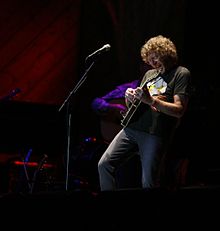
New Grass Revival mandolinist Sam Bush-league in 2012, who described "I've Just Seen a Face" as the first vocal by the Beatles to which he could relate.
Also the Charles River Valley Boys, numerous bluegrass groups have covered the vocal.[93] Doggett writes the tempo and chord changes of "I've Simply Seen a Face" "[cry] out for a banjo and mandolin",[116] and Turner argues information technology has been "key in stimulating a relationship between bluegrass and the music of the Beatles".[117] The progressive bluegrass band the Dillards recorded a embrace of the song between the British release of Help! and the North American release of Safety Soul; they had hoped to consequence the song in the US before the Beatles, though the recording went unreleased.[118] They after recorded a cover for their 1968 album Wheatstraw Suite.[119] Joining elements of traditional mountain music and modernistic country music, their version includes high harmonies, a banjo and a pedal steel guitar.[93] Unterberger calls information technology "a respectable version" which "completed [the Dillards'] move from bluegrass into folk-country-stone",[33] while Turner describes it as "relaxed in tempo and wistful", writing that its utilize of a pedal steel guitar is "a clear salute to the flourishing folk-rock scene".[117] Kruth suggests that the finished recording influenced bands like the Byrds, the Grateful Dead and the Eagles.[93]
Sam Bush, mandolinist for the progressive bluegrass band New Grass Revival, recalled beingness uninterested in rock music before the mid-1960s, only constitute that "I've Just Seen a Face" allowed him to "relate to the Beatles for the first time", like-minded with a characterisation of it as "bluegrass without a banjo".[120] New Grass Revival subsequently covered the vocal with musician Leon Russell for their 1981 live album, The Alive Album, a version Turner calls "hard driving" and "erratic".[121] Bush later covered the song as a solo artist for the 2013 Americana tribute album, Permit United states in Americana: The Music of Paul McCartney.[122] The group Bluegrass Association recorded the song for their 1974 album Strings Today... And Yesterday, basing their arrangement on the Charles River Valley Boys' version.[123]
Other artists [edit]
George Martin recorded an orchestral version of the song for his 1965 easy listening album, George Martin & His Orchestra Play Help!, credited under its original working title, "Auntie Gin'south Theme".[124] In a review of the album for AllMusic, Bruce Eder describes Martin'southward recordings every bit "tasteful but otherwise largely undistinguished". He credits the release of tracks under their working titles as one of the album's unique selling points, beingness "details that Beatles fanatics of the time merely devoured".[125] The Grateful Dead performed the vocal in concert on 11 June 1969 in San Francisco, playing pseudonymously as Bobby Ace and the Cards from the Bottom of the Deck, and one-time Grateful Dead keyboardist Tom Constanten recorded a cover for his 1993 album Morning Dew.[126] Hank Crawford, the alto saxophonist of Ray Charles, recorded a funk and reggae-inspired version of the vocal for his 1976 album Tico Rico.[93]
Canadian jazz singer Holly Cole covered the song for her 1997 album Night Dear Heart.[127] Released with a noir-style music video,[127] the version reached number seven on Canada's RPM Top Singles Chart in November 1997.[128] The 2007 jukebox musical romantic drama film Beyond the Universe features a cover of the song,[127] later included on its associated soundtrack album.[129] In the film, the lead character, Jude (Jim Sturgess), sings about Lucy (Evan Rachel Woods) at a bowling aisle in what Kruth terms a "somewhat bizarre love-fantasy scene".[127] Reviewing the soundtrack for AllMusic, Erlewine writes that Sturgess does "a credible job" on the song's "rockabilly revamp".[129] American vocalist Brandi Carlile occasionally sings the song during alive shows.[127] Though Kruth disparages Carlile's version as "[not] particularly different or innovative",[127] a 2010 ranking by Paste magazine of the 50 best Beatles covers placed information technology at 46, writing that she transforms the song into a "sing-forth hoe-down".[130] Kruth designates "I'll Just Bleed Your Face" as the song's "most bizarre" cover,[127] recorded by Beatallica – a mashup group of heavy metal band Metallica and the Beatles – for their 2009 album Masterful Mystery Tour.[131]
Personnel [edit]
According to Walter Everett,[22] except where noted:
- Paul McCartney – lead vocal, harmony vocal, nylon-string guitar
- John Lennon – acoustic rhythm guitar
- George Harrison – acoustic twelve-string guitar
- Ringo Starr – drums (with brushes),[132] maracas[133]
Notes [edit]
- ^ Virginia "Gin" Harris was the younger sister of McCartney's male parent, Jim McCartney.[viii] McCartney afterwards referenced her in the song "Let 'Em In",[9] released on the 1976 album Wings at the Speed of Sound.[10]
- ^ The four A-sides were "A Hard Day'south Night", "I Feel Fine", "Ticket to Ride" and "Help!"[xvi] The pair co-wrote "Viii Days a Week",[17] released every bit a single in the United States in February 1965.[eighteen]
- ^ Everett writes the song is in cutting time.[22] Pollack writes that the vocal can be counted in either ii/2 or 4/four (common time), but that if counted in the quondam, the listener can "more easily grasp the extent to which the underlying tempo is abiding".[20]
- ^ Recorded a day after "I've Just Seen a Face",[42] the song "It'southward Merely Love" sometimes employs similar phrasing patterns.[43] Everett hypothesises that Lennon composed "It's Just Love" in an effort to friction match the rhyming effect of "I've Merely Seen a Face", merely ultimately finds information technology "Lennon'south most forced endeavor at rhyming".[44]
- ^ Author Adam Gopnik describes the solar day every bit "a memorable high-water marker in musical history",[51] while Sheffield and McCartney each comment that it provides a sense of the Beatles' quick recording practices.[52]
- ^ Amid Beatles authors, Gould and John C. Winn each say that Harrison played the solo.[58] Jean-Michael Guesdon & Philippe Margotin write McCartney played it with his Epiphone Texan, only limited general uncertainty over what guitar parts McCartney and Harrison contributed.[10]
- ^ The effect appears on their covers of "Dizzy, Miss Lizzy" and "Bad Male child", besides equally on "Yes Information technology Is", "The Night Before", "Help!", "Information technology's Merely Love" and "Ticket to Ride", where Harrison's opening twelve-string ostinato contrasts with iii overdubbed guitars.[59]
- ^ When the Beatles' catalogue was remastered for stereo in 2009, the Assist! CD retained Martin's 1987 remix. The original stereo mix was included as a bonus on the companion release The Beatles in Mono.[62]
- ^ The album was a commercial success and, according to Gould, served to attract folk-music enthusiasts towards popular music.[78]
- ^ The other picks included "Lady Madonna", "The Long and Winding Road", "Yesterday" and "Blackbird".[97]
References [edit]
Citations [edit]
- ^ a b c d due east f MacDonald 2007, p. 155.
- ^ Sheff 2000, p. 195: Lennon; Miles 1997, p. 200: McCartney.
- ^ Miles 1997, pp. 107–108.
- ^ Miles 1997, pp. 103–104; Shea & Rodriguez 2007, p. 363.
- ^ Davies 2019, p. 320: piano; Everett 2001, p. 299: melody first; Miles 1997, p. 200: uptempo state and western-inflected.
- ^ a b c Kruth 2015, p. 51.
- ^ Badman 2001, p. 97; Turner 2005, p. 83; Shea & Rodriguez 2007, p. 285.
- ^ Womack 2014, p. 484; Turner 2005, p. 83; Lewisohn 2013, pp. x, 25, 906.
- ^ Turner 2005, p. 83; Shea & Rodriguez 2007, p. 285.
- ^ a b c Guesdon & Margotin 2013, p. 248.
- ^ MacDonald 2007, p. 155: fast-paced lyrics added; Hertsgaard 1995, p. 132: cheerful love ballad; Guesdon & Margotin 2013, p. 248; Norman 2016, p. 196 and Davies 2019, p. 320: Asher possible inspiration.
- ^ Everett 2001, pp. 280, 296, 304–305.
- ^ Lewisohn 2000, p. 195; Miles 1997, p. 205.
- ^ Miles 2001, pp. 197, 198; Miles 1997, pp. 204–205.
- ^ Sounes 2010, p. 125; Miles 2001, p. 196.
- ^ Castleman & Podrazik 1976, pp. 34, 40, 46, 47; Womack 2009, p. 286.
- ^ MacDonald 2007, pp. 132, 155.
- ^ Castleman & Podrazik 1976, p. 45; Womack 2009, p. 290.
- ^ MacDonald 2007, p. 155; Doggett 2005, p. 65.
- ^ a b c d e f grand h i j k l m n o p q r southward Pollack, Alan W. (1993). "Notes on 'I've Just Seen a Face'". soundscapes.info. Archived from the original on 12 June 2021. Retrieved 28 July 2021.
- ^ Everett 2001, p. 299: cut time; MacDonald 2007, pp. 155, 495: A major.
- ^ a b c d e f Everett 2001, p. 299.
- ^ a b c d e f k Riley 2002, p. 148.
- ^ a b c O'Grady 1979, p. 88; O'Grady 1983, p. eighty.
- ^ Everett 2009, p. 228.
- ^ a b Turner 2016, p. 85.
- ^ MacDonald 2007, p. 156.
- ^ Everett 2001, pp. 299, 337.
- ^ Everett 1999, p. 186.
- ^ a b O'Grady 2008, p. 24.
- ^ O'Grady 1979, p. 89.
- ^ Ingham 2009, p. 34.
- ^ a b Unterberger, Richie. "The Beatles – I've Just Seen a Face". AllMusic. Archived from the original on 15 October 2014. Retrieved 28 July 2021.
- ^ Unterberger 2002, p. 272.
- ^ a b c "100 Greatest Beatles Songs: 58. 'I've Merely Seen a Face'". Rolling Rock. 10 April 2020. Archived from the original on 13 July 2021.
- ^ MacDonald 2007, p. 155; Gould 2007, p. 278.
- ^ a b Gould 2007, p. 278.
- ^ Gould 2007, p. 302.
- ^ Wagner 2008, p. 89.
- ^ Everett 2001, p. 403n137.
- ^ a b c Miles 1997, p. 200.
- ^ Everett 2001, pp. 299, 303.
- ^ Pollack, Alan Westward. (1993). "Notes on 'It'due south Simply Love'". soundscapes.info. Archived from the original on xx October 2021. Retrieved 22 January 2022.
- ^ Everett 2001, p. 303.
- ^ Lewisohn 2000, p. 193.
- ^ a b c d Winn 2008, p. 324.
- ^ a b Lewisohn 1988, p. 59.
- ^ Lewisohn 2000, p. 195; Lewisohn 1988, p. 59.
- ^ Lewisohn 1988, p. 59; Hertsgaard 1995, p. 132; Guesdon & Margotin 2013, pp. 248, 266; Shea & Rodriguez 2007, p. 285.
- ^ Pollack, Alan West. (1992). "Notes on 'I'1000 Downwards'". soundscapes.info. Archived from the original on 30 November 2020. Retrieved 22 October 2021.
- ^ Gopnik, Adam (5 September 2011). "Pass up, Autumn, Rinse, Repeat". The New Yorker. Archived from the original on 2 July 2021.
- ^ Sheffield 2017, p. 96; Babiuk 2002, p. 162.
- ^ Everett 2001, pp. 299, 346: instrumentation and personnel on showtime bones runway; MacDonald 2007, p. 155: Starr on brushed snare; Womack 2014, p. 484 and Guesdon & Margotin 2013, p. 248: Epiphone Texan.
- ^ Everett 2001, p. 299: personnel; Womack 2014, p. 484: Gibson J-160E.
- ^ Everett 2001, p. 299: college section with nylon-string acoustic, descant song; Guesdon & Margotin 2013, p. 248: Epiphone Texan.
- ^ Baur 2017, p. 182n5.
- ^ Everett 2009, pp. 61, 346 and Everett 2006, p. 79: twelve-string acoustic solo; Winn 2008, p. 324 and Gould 2007, p. 278: solo by Harrison.
- ^ Gould 2007, p. 278; Winn 2008, p. 324.
- ^ a b Everett 2006, p. 79.
- ^ Lewisohn 1988, p. lx.
- ^ Everett 2001, pp. 304, 408n84.
- ^ Erlewine, Stephen Thomas. "The Beatles – The Beatles: Stereo Box Set ". AllMusic. Archived from the original on 19 October 2021. Retrieved 7 November 2021.
- ^ Castleman & Podrazik 1976, p. 47; Womack 2009, p. 288.
- ^ Lewisohn 1988, p. 62; Miles 2001, p. 203; Everett 2001, pp. 304–305.
- ^ Frontani 2007, pp. 53, 116; Rodriguez 2012, pp. 24–25.
- ^ Miles 2001, p. 206; Kimsey 2009, pp. 233–234.
- ^ Kruth 2015, p. 7.
- ^ MacDonald 2007, p. 156; Gould 2007, p. 296.
- ^ MacDonald 2007, p. 154.
- ^ Kruth 2015, p. 49.
- ^ Kimsey 2009, p. 235: Memphis sound; Jackson 2015, p. 181: replacement as opening runway to brand album sound folk-rock; Turner 2016, p. 83: before "Norwegian Wood".
- ^ Castleman & Podrazik 1976, p. 50; Womack 2009, p. 292.
- ^ Kimsey 2009, p. 235; Rodriguez 2012, p. 75; Frontani 2007, p. 116; Womack 2014, p. 794.
- ^ Gould 2007, p. 296; Kimsey 2009, p. 235; Unterberger 2002, p. 180.
- ^ Sheffield 2004, p. 52: O'Grady 1979, pp. 87–88; O'Grady 1983, pp. 79–80 and Marsh 2007, p. 122.
- ^ Hamilton 2016, p. 148; Philo 2014, p. 88; Courrier 2009, p. 114.
- ^ Gould 2007, p. 296; Fusilli 2005, p. 78 and Marsh 2007, pp. 122, 177.
- ^ Gould 2007, p. 296.
- ^ Erlewine, Stephen Thomas. "The Beatles – Assist!". AllMusic. Archived from the original on 21 July 2021. Retrieved 28 July 2021.
- ^ Jackson 2015, p. 181.
- ^ a b Petridis 2004, p. 176.
- ^ Ewing, Tom (8 September 2009). "The Beatles: Assistance!". Pitchfork. Archived from the original on 25 February 2021.
- ^ Kozinn 1995, p. 129.
- ^ a b Womack 2014, p. 484.
- ^ "10 Great Early on Beatles Songs". Rolling Stone. 12 February 2014. Archived from the original on 28 July 2021.
- ^ Carlin 2009, p. 117.
- ^ Riley 2002, p. 148; Carlin 2009, p. 117; Everett 2001, p. 403n137.
- ^ Sheffield 2017, p. 90.
- ^ Sheffield 2017, pp. 15–xvi.
- ^ Hertsgaard 1995, pp. 127, 132–133.
- ^ Unterberger 2002, p. 181.
- ^ Kruth 2015, p. 52.
- ^ a b c d e Kruth 2015, p. 54.
- ^ Kot 2006, p. 326.
- ^ Badman 2001, pp. 165, 182–183; Rodriguez 2010, pp. 63, 173.
- ^ Norman 2016, p. 516; Ingham 2009, p. 66.
- ^ Schaffner 1977, p. 182; Rodriguez 2010, pp. 172–173.
- ^ Rodriguez 2010, p. 173.
- ^ a b Schaffner 1977, p. 182.
- ^ Schaffner 1977, p. 182; Rodriguez 2010, p. 63.
- ^ Womack 2014, pp. 961–962, 1203–1204.
- ^ Badman 2001, p. 459.
- ^ Ingham 2009, p. 111.
- ^ Ingham 2009, p. 111; Badman 2001, p. 462.
- ^ Blistein, Jon (16 February 2015). "Paul McCartney, Miley Cyrus, Paul Simon Captivate at 'SNL 40'". Rolling Stone. Archived from the original on 15 April 2021.
- ^ Kruth 2015, pp. 30, 54, 169.
- ^ a b c d Turner 2016, p. 84.
- ^ Turner 2016, p. 85: normal setlist, added "I've Just Seen a Face" and "What Goes On"; Frontani 2007, p. 117: "What Goes On" being state inflected.
- ^ Turner 2016, p. 87.
- ^ Turner 2016, pp. 84–86.
- ^ Turner 2016, p. 90.
- ^ Turner 2016, pp. 79, 88.
- ^ Cash Box Review Console (3 December 1966). "Album Reviews" (PDF). Greenbacks Box. p. 62. Archived (PDF) from the original on four January 2022.
- ^ Paul, John (12 October 2016). "Bargain Bin: The Charles River Valley Boys: Beatle State". Spectrum Culture. Archived from the original on 4 Feb 2017.
- ^ Turner 2016, p. 80.
- ^ Doggett 2001, p. 306.
- ^ a b Turner 2016, p. 83.
- ^ Einarson 2001, p. 46.
- ^ Unterberger 2003, p. 186.
- ^ Harris 2018, p. 244.
- ^ Turner 2016, pp. 78, 84.
- ^ Zolten 2020, p. 242.
- ^ Hambly 1976, p. 509.
- ^ Castleman & Podrazik 1976, p. 278: 1965 album; Schaffner 1977, p. 213: orchestral, easy listening; Everett 2001, p. 299: George Martin & His Orchestra Play Aid!.
- ^ Eder, Bruce. "George Martin & His Orchestra – George Martin Plays 'Assistance'". AllMusic. Archived from the original on 5 April 2017. Retrieved 29 July 2021.
- ^ Trager 1997, pp. 209, 269.
- ^ a b c d e f yard Kruth 2015, p. 55.
- ^ "Top RPM Singles: Issue 3389". RPM. Library and Archives Canada. Retrieved 30 July 2021.
- ^ a b Erlewine, Stephen Thomas. "Various Artists – Beyond the Universe [Original Soundtrack]". AllMusic. Archived from the original on 25 July 2021. Retrieved xix October 2021.
- ^ Jackson, Josh (17 Nov 2010). "The 50 All-time Beatles Covers of All Time". Paste. Archived from the original on 25 February 2021.
- ^ Womack 2014, p. 484; Kruth 2015, p. 55.
- ^ MacDonald 2007, p. 155; Guesdon & Margotin 2013, p. 248; Kruth 2015, p. 51.
- ^ MacDonald 2007, p. 155; Guesdon & Margotin 2013, p. 248; Baur 2017, p. 182n5.
Sources [edit]
- Babiuk, Andy (2002). Beatles Gear: All the Fab Four's Instruments from Stage to Studio (Second (revised) ed.). San Francisco: Backbeat Books. ISBN0-87930-731-v.
- Badman, Keith (2001). The Beatles Diary Volume 2: After The Suspension-Up 1970–2001. London: Omnibus Press. ISBN0-7119-8307-0.
- Baur, Steven (2017). "Ringo and Revolver: rhythm, timbre, and tempo in rock drumming". In Reising, Russell (ed.). 'Every Audio There Is': The Beatles' Revolver and the Transformation of Rock and Roll. Abingdon-on-Thames: Routledge. pp. 171–182. ISBN978-1-351-21868-ix.
- Carlin, Peter Ames (2009). Paul McCartney . New York: Simon & Schuster. ISBN978-one-4165-6223-viii.
- Castleman, Harry; Podrazik, Walter J. (1976). All Together Now: The Kickoff Complete Beatles Discography, 1961–1975 . New York: Ballantine Books. ISBN0-345-25680-8.
- Courrier, Kevin (2009). Bogus Paradise: The Night Side of the Beatles' Utopian Dream. Santa Barbara: ABC-CLIO. ISBN978-0-313-34587-6.
- Davies, Hunter (2019) [2016]. The Beatles Book. London: Ebury Publishing. ISBN978-0-09-195863-3.
- Doggett, Peter (2001). Are You Ready for the Country: Elvis, Dylan, Parsons and the Roots of Country Rock . New York: Penguin Books. ISBN0-xiv-200016-7.
- Doggett, Peter (2005). The Fine art and Music of John Lennon . London: Passenger vehicle Press. ISBN978-1-84449-954-0.
- Einarson, John (2001). Desperados: The Roots of Land Stone . New York: Cooper Square Press. ISBN978-one-4616-0733-five.
- Everett, Walter (1999). The Beatles as Musicians: Revolver through the Anthology . New York: Oxford University Printing. ISBN978-0-19-512941-0.
- Everett, Walter (2001). The Beatles as Musicians: The Quarry Men through Rubber Soul . New York: Oxford Academy Press. ISBN978-0-19-514105-iv.
- Everett, Walter (2006). "Painting Their Room in a Colorful Way: The Beatles' Exploration of Timbre". In Womack, Kenneth; Davis, Todd F. (eds.). Reading the Beatles: Cultural Studies, Literary Criticism, and the Fab Four. Albany: State University of New York Press. pp. 71–94. ISBN0-7914-6716-three.
- Everett, Walter (2009). The Foundations of Rock: From "Blue Suede Shoes" to "Suite: Judy Blue Eyes". Oxford: Oxford Academy Press. ISBN978-0-19-531024-v.
- Frontani, Michael R. (2007). The Beatles: Image and the Media. Jackson: University Press of Mississippi. ISBN978-1-57806-966-eight.
- Fusilli, Jim (2005). The Beach Boys' Pet Sounds . 33⅓. New York: Bloomsbury Publishing. ISBN978-1-4411-1266-eight.
- Gould, Jonathan (2007). Can't Purchase Me Love: The Beatles, Britain, and America . New York: Three Rivers Printing. ISBN978-0-307-35338-2.
- Guesdon, Jean-Michel; Margotin, Philippe (2013). All the Songs: The Story Behind Every Beatles Release. New York: Black Dog & Leventhal Publishers. ISBN978-ane-57912-952-1.
- Hambly, Scott (1976). "Bluegrass Records: A Review Article". Journal of American Folklore. 89 (354): 501–511. doi:10.2307/539307. ISSN 0021-8715.
- Hamilton, Jack (2016). Just Effectually Midnight: Stone and Scroll and the Racial Imagination. Cambridge: Harvard Academy Printing. ISBN978-0-674-97356-five.
- Harris, Craig (2018). Bluegrass, Newgrass, Old-Time, and Americana Music. Gretna: Arcadia Publishing. ISBN978-1-4556-2402-seven.
- Hertsgaard, Mark (1995). A Day in the Life: The Music and Artistry of the Beatles . New York: Delacorte Printing. ISBN0-385-31377-2.
- Ingham, Chris (2009). The Rough Guide to the Beatles (3rd ed.). London: Rough Guides. ISBN978-1-84836-525-4.
- Jackson, Andrew Grant (2015). 1965: The Most Revolutionary Yr in Music . New York: Macmillan Publishers. ISBN978-1-4668-6497-9.
- Kozinn, Allan (1995). The Beatles . London: Phaidon Printing. ISBN0-7148-3203-0.
- Kimsey, John (2009). "'An brainchild, like Christmas': the Beatles for auction and for keeps". In Womack, Kenneth (ed.). The Cambridge Companion to the Beatles. Cambridge: Cambridge University Press. pp. 230–254. ISBN978-0-521-68976-two.
- Kot, Greg (2006). "'Toppermost of the Poppermost'". In Sawyers, June Skinner (ed.). Read the Beatles: Classic and New Writings on the Beatles, Their Legacy, and Why They However Affair. New York: Penguin Books. pp. 322–326. ISBN978-0-fourteen-303732-3.
- Kruth, John (2015). This Bird Has Flown: The Enduring Beauty of Prophylactic Soul, 50 Years On. Milwaukee: Backbeat Books. ISBN978-one-61713-573-6.
- Lewisohn, Mark (1988). The Consummate Beatles Recording Sessions . New York: Harmony Books. ISBN978-0-600-63561-1.
- Lewisohn, Mark (2000) [1992]. The Complete Beatles Relate: The Only Definitive Guide to the Beatles' Entire Career . London: Hamlyn. ISBN0-600-60033-5.
- Lewisohn, Marker (2013). The Beatles – All These Years, Volume One: Tune In . New York: Iii Rivers Press. ISBN978-ane-101-90329-2.
- MacDonald, Ian (2007). Revolution in the Head: The Beatles' Records and the Sixties (Third ed.). Chicago: Chicago Review Printing. ISBN978-1-55652-733-3.
- Marsh, Dave (2007). The Beatles' 2nd Album. New York: Rodale. ISBN978-one-59486-426-1.
- Miles, Barry (1997). Paul McCartney: Many Years from Now . New York: Henry Holt. ISBN0-8050-5249-6.
- Miles, Barry (2001). The Beatles Diary Volume one: The Beatles Years. London: Bus Printing. ISBN978-0-7119-8308-3.
- Norman, Philip (2016). Paul McCartney: The Life . New York: Little, Chocolate-brown and Company. ISBN978-0-316-32796-one.
- O'Grady, Terence J. (1979). "Condom Soul and the Social Dance Tradition". Ethnomusicology. 23 (ane): 87–94. doi:10.2307/851340. ISSN 0014-1836.
- O'Grady, Terence J. (1983). The Beatles: A Musical Development . Boston: Twayne. ISBN0-8057-9453-0.
- O'Grady, Terence J. (2008). "Sgt. Pepper and the diverging aesthetics of Lennon and McCartney". In Julien, Olivier (ed.). Sgt. Pepper and the Beatles: Information technology was Forty Years Ago Today. Aldershot: Ashgate Publishing. pp. 23–32. ISBN0-7546-6708-1.
- Petridis, Alexis (2004). "Help! Period of adjustment". In Trynka, Paul (ed.). The Beatles: Ten Years that Shook the World. London: Dorling Kindersley. pp. 176–177. ISBN0-7566-0670-5.
- Philo, Simon (2014). British Invasion: The Crosscurrents of Musical Influence. Lanham: Rowman & Littlefield. ISBN0-8108-8627-8.
- Riley, Tim (2002). Tell Me Why: The Beatles: Anthology by Anthology, Song by Song, the Sixties and After (Revised and Updated ed.). Cambridge: Da Capo Press. ISBN978-0-306-81120-3.
- Rodriguez, Robert (2010). Fab 4 FAQ two.0: The Beatles' Solo Years, 1970–1980. New York: Backbeat Books. ISBN978-0-87930-968-viii.
- Rodriguez, Robert (2012). Revolver: How the Beatles Re-Imagined Rock 'n' Roll . Montclair: Backbeat Books. ISBN978-i-61713-009-0.
- Schaffner, Nicholas (1977). The Beatles Forever . Harrisburg: Cameron House. ISBN0-8117-0225-ane.
- Shea, Stuart; Rodriguez, Robert (2007). Fab Iv FAQ: Everything Left to Know About the Beatles... and More than! . New York: Hal Leonard Books. ISBN978-one-4234-2138-2.
- Sheff, David (2000) [1981]. Golson, Yard. Barry (ed.). All We Are Maxim: The Concluding Major Interview with John Lennon and Yoko Ono . New York: St. Martin'southward Griffin. ISBN0-312-25464-4.
- Sheffield, Rob (2004). "The Beatles". In Brackett, Nathan; Hoard, Christian (eds.). The New Rolling Stone Album Guide (quaternary ed.). New York: Fireside/Simon & Schuster. pp. 51–54. ISBN0-7432-0169-8.
- Sheffield, Rob (2017). Dreaming the Beatles: The Love Story of 1 Band and the Whole World. New York: HarperCollins. ISBN978-0-06-220765-four.
- Sounes, Howard (2010). Fab: An Intimate Life of Paul McCartney . London: HarperCollins. ISBN978-0-00-723705-0.
- Trager, Oliver (1997). The American Book of the Dead: The Definitive Grateful Dead Encyclopedia . New York: Simon & Schuster. ISBN978-0-684-81402-five.
- Turner, Laura (2016). "Beatle Country: A Bluegrass 'Concept Album' from 1966". In Womack, Kenneth (ed.). New Critical Perspectives on the Beatles: Things We Said Today. London: Palgrave Macmillan. pp. 77–94. ISBN978-1-137-57013-0.
- Turner, Steve (2005). A Hard Mean solar day'southward Write: The Stories Behind Every Beatles Song (New and Updated ed.). New York: HarperCollins. ISBN978-0-06-084409-7.
- Unterberger, Richie (2002). Turn! Turn! Turn!: The '60s Folk-Rock Revolution . San Francisco: Backbeat Books. ISBN0-87930-703-X.
- Unterberger, Richie (2003). Eight Miles High: Folk-Rock's Flight from Haight-Ashbury to Woodstock . San Francisco: Backbeat Books. ISBN0-87930-743-nine.
- Wagner, Naphtali (2008). "The Beatles' psycheclassical synthesis: psychedelic classicism and classical psychedelia in Sgt. Pepper". In Julien, Olivier (ed.). Sgt. Pepper and the Beatles: It was Forty Years Ago Today. Aldershot: Ashgate Publishing. pp. 75–90. ISBN0-7546-6708-1.
- Winn, John C. (2008). Way Across Compare: The Beatles' Recorded Legacy, Volume I, 1957–1965. New York: Three Rivers Press. ISBN978-0-307-45157-6.
- Womack, Kenneth, ed. (2009). "Beatles Discography, 1962–1970". The Cambridge Companion to the Beatles. Cambridge: Cambridge University Press. pp. 286–293. ISBN978-0-521-68976-two.
- Womack, Kenneth (2014). The Beatles Encyclopedia: Everything Fab Four . Santa Barbara: Greenwood. ISBN978-0-313-39171-2.
- Zolten, Jerry (2020). "On the Record! (Dis)Covering the Beatles". In Womack, Kenneth (ed.). The Beatles in Context. New York: Cambridge University Press. pp. 230–244. ISBN978-1-108-40952-0.
External links [edit]
- Full lyrics for the song at the Beatles' official website
- The Beatles – I've Merely Seen A Face up (Remastered 2009) on YouTube
- Paul McCartney – I've Simply Seen A Face up (Alive / Wings over America / Remastered) on YouTube
- Paul McCartney – I've Just Seen a Confront (Live / Unplugged (The Official Bootleg)) on YouTube
- The Dillards – I've Just Seen a Face on YouTube
- Hank Crawford – I've Just Seen a Confront on YouTube
- Holly Cole – I've Just Seen a Face up on YouTube
- Hosts Monologue – Sat Dark Live 40th Anniversary Special, including Paul McCartney and Paul Simon playing "I've Just Seen a Face" on YouTube
- Jim Sturgess – I've Just Seen A Face (From "Across The Universe" Soundtrack) on YouTube
- Leon Russell and New Grass Revival – I've Just Seen a Face (Live / The Live Anthology) on YouTube
Source: https://en.wikipedia.org/wiki/I%27ve_Just_Seen_a_Face
0 Response to "And Shes Keep Calling Me Back Again Beatles"
Post a Comment